The "Hallway Pass" to Your Property: Understanding the Basics
Imagine you are in school and have a hallway pass. That pass gives you the right to be in the corridor for a specific purpose—getting to the library or the restroom—but it doesn't mean you own the hallway or are invited to move your desk in and stay forever. In property law, this is exactly what an easement is.
Technically, an easement is a "nonpossessory interest" in land. This means that while someone else has a legal right to use a portion of your property for a specific reason, they do not own that land. You remain the owner, but you have granted (or the law has created) a limited "pass" for someone else to enter or use a specific area. They are, as the legal saying goes, "welcome to pass, but not to stay."
|
Ownership (Fee Simple) |
Right to Use (Easement) |
|
Full Control: The right to possess, sell, and occupy the entire property. |
Limited Use: Permission is restricted to a specific purpose (like pipes or walking). |
|
Possessory: You are the resident owner with the right to stay. |
Nonpossessory: The holder is just "passing through." |
Knowing the definition is power—but knowing your role in the relationship is where the strategy begins.
The Dominant and the Servient: Who’s Who?
In every easement relationship, there are two primary roles. Identifying which side of the fence you sit on determines your rights and your chores.
- The Dominant Estate: This is the property or entity that receives the benefit. If your neighbor uses a path on your land to reach the lake, their property is the "dominant" one.
- The Servient Estate: This is the land that bears the "burden." As the homeowner whose land is being used, you are the servient estate.
The Advocate’s "So What?" Being the servient estate sounds like a heavy lift, but there is a major silver lining: the duty to repair and maintain the easement generally rests on the dominant estate. If a shared driveway develops a pothole, you usually aren't the one stuck with the repair bill; that responsibility falls to the neighbor who benefits from the access.
However, your role does come with restrictions. You cannot build structures—like fences, sheds, or barns—that interfere with the easement holder's rights. If you block their "pass," you could be looking at a court order to tear down your new project at your own expense.
Mastering the roles is step one; now, let’s look at the three legal forms these rights can take.
The Three Pillars: Affirmative, Negative, and Prescriptive Rights
Not all easements are created equal. They generally fall into three categories based on how they function or how they were earned over time.
Easement Cheat Sheet
|
Type of Easement |
Simple Definition |
Everyday Scenario |
|
Affirmative |
Allows the holder to perform a specific action on your land. |
A neighbor driving across your path to reach their landlocked home. |
|
Negative |
Prevents the landowner from doing something on their own land. |
A restriction stopping you from building a tall structure that blocks a neighbor’s light or view. |
|
Prescriptive |
A right gained through long-term, unauthorized, open use. |
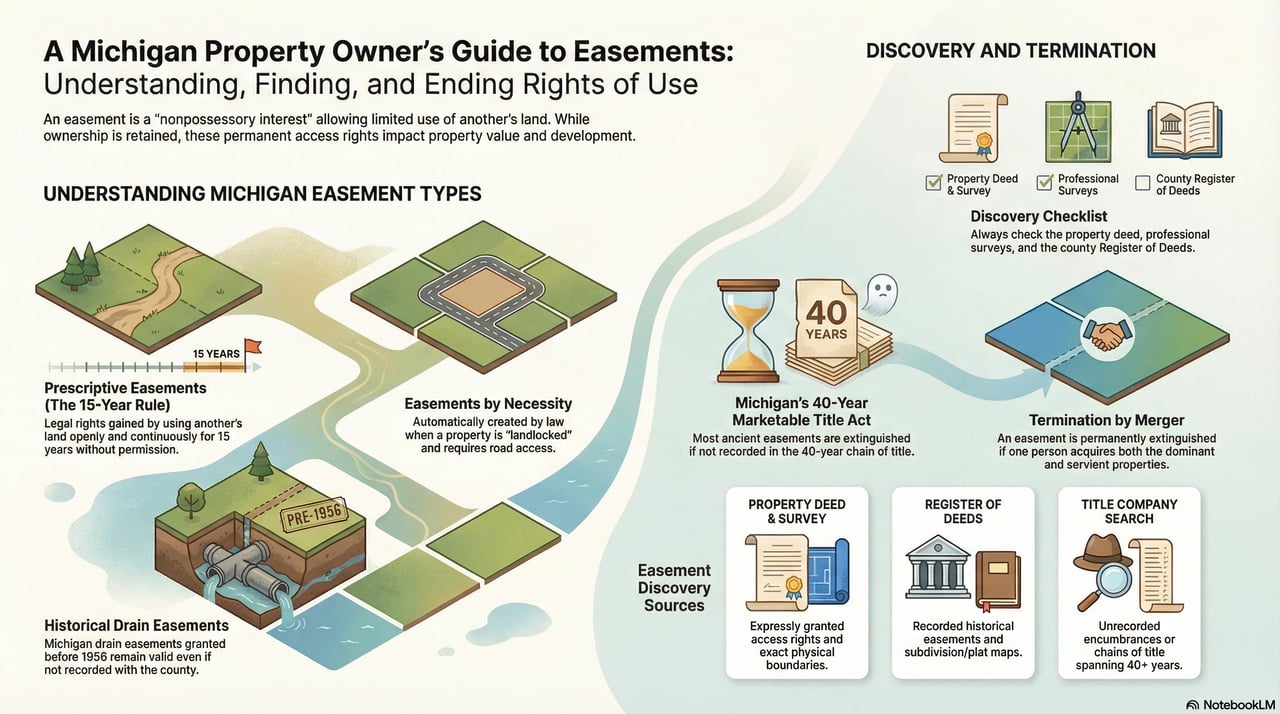
The Michigan 15-Year Rule: If someone uses a shortcut across your yard openly and without permission for 15+ years, they may vest a legal right to keep doing it. |
The legal theory is the foundation, but easements usually manifest in your daily life as something much more concrete.
Real-World Scenarios: From Sidewalks to Power Lines
Easements are a standard part of community infrastructure. You’ll likely encounter one of these four common types:
- Public and Utility Easements ("Easements in Gross") These aren't tied to a neighbor's house, but to a specific company or government entity. Utility companies use these to maintain power lines or underground pipes.
- Private and Neighborhood Easements ("Easements Appurtenant") These benefit a specific piece of land. Think of shared driveways or neighborhood-wide access to a nearby beach. These "run with the land," meaning they stay attached to the property even when it’s sold.
- Easements by Necessity The law favors the "productive use of land." If a piece of property is "landlocked" with no road access, a court may create an easement by necessity to ensure the owner can actually use their property.
- County Drains A county drain might be an open ditch or an underground pipe. In Michigan, the Drain Commissioner must have an easement to keep the water flowing.
Easements "run with the land," meaning they stick around long after the original owners are gone—so you’ll want to be a bit of a detective before you buy.
The Property Detective: How to Find Easements on Your Land
You don't want to find out about a "hallway pass" across your yard after you've started digging a swimming pool. Use this checklist to uncover existing rights:
- [ ] Property Deeds: Check for the phrase "subject to all easements of record."
- [ ] Property Surveys: A professional survey will show exact boundaries and visible access paths.
- [ ] County Register of Deeds: Search for recorded maps or legal agreements.
- [ ] Subdivision or Plat Maps: Easements are often marked on the original community blueprints.
- [ ] Utility Companies: Contact them directly to see if they have infrastructure rights on your lot.
- [ ] Title Commitment Search: Always hire a professional title company.
The 1956 Caveat: In Michigan, drainage easements granted before 1956 were not required to be recorded with the Register of Deeds. Even if they don't show up on a standard title search, they are still legally valid!
Beyond the Path: Checking for "Clouds" Being a detective also means looking for "expired options" or potential litigation. Sometimes a seller claims they have the right to grant an easement, but their own "option to purchase" the land has expired. Always ensure your title work includes a litigation search; you can’t sell or grant rights to what you don't legally own.
Finding an easement is vital for your peace of mind, but it’s also important to know that these legal ties can occasionally be cut.
Breaking the Bond: How Easements Are Terminated
Easements can be permanent, but they aren't immortal. Here are the five primary ways they can be legally extinguished:
- Express Release: The easement holder signs a written agreement (which must satisfy the Statute of Frauds) giving up their rights.
- Abandonment: The holder stops using the easement and performs an affirmative act showing they intend to give it up. (Note: In Michigan, if a prescriptive easement isn't used for 15 years, it may be extinguished even without an overt act).
- Merger: If one person buys both the dominant and the servient properties, the easement disappears. You cannot have an easement over your own land!
- End of Necessity: If a landlocked property finally gets access to a new public road, the "necessity" ends, and the easement may be terminated.
- Marketable Title Act: Michigan law allows certain ancient interests to be ignored if they are more than 40 years old and have not been recently recorded or used.
Even with clear exit strategies, sharing your land can still lead to the occasional "fence war" if you aren't prepared.
Avoiding "Fence Wars": Disputes and Maintenance
Living with an easement requires a "live and let live" approach, backed by clear legal boundaries.
The Dos and Don'ts of Easement Management
- DO provide a key if you install a gate. You can improve your land, but you cannot interfere with the holder’s access.
- DO remember that the dominant estate (the user) typically has the right and duty to repair potholes or maintain the path.
- DON'T exceed the "scope" of the easement. If you have a right to walk across a neighbor’s sidewalk, you cannot set up a lawn chair and sunbathe there. That is trespassing.
- DON'T assume misuse is a minor issue. Michigan is one of the few states where a court may actually terminate an easement entirely if the holder misuses it so badly that the burden on your land cannot be severed.
Standing your ground is easier when you know exactly where the lines are drawn.
Easements are a fundamental part of property ownership. They ensure that neighbors can reach their homes, utility companies can keep the lights on, and community infrastructure like drains can function properly. They are essential tools that favor the "productive use of land"—ensuring no parcel sits useless and inaccessible.
Before you purchase a property, always walk the land to look for physical signs of use (like worn paths or utility markers) and perform a thorough title search. If boundaries are unclear or a dispute arises, consult a professional before taking any "hostile" actions.
The So What? Easements are not just legal "hallway passes"—they are essential tools for community infrastructure and property utility. By understanding them, you transform from a nervous buyer into an empowered homeowner who knows exactly where their rights begin and where their neighbor’s access ends.
Amanda's Take
If there is one thing I have learned, both personally and professionally, it is that easements are one of those parts of homeownership that feel unimportant until they suddenly matter. Most of the time they are completely normal, like utility lines, shared driveways, and county drains, and they quietly keep neighborhoods functioning. But because an easement is essentially a legal hallway pass across your land, it is worth understanding exactly what that pass allows and what it does not. The empowering part is this: an easement does not mean you are losing ownership, it means you are sharing limited use for a specific purpose within a defined scope. When you know whether you are the dominant or servient estate, what maintenance responsibilities typically look like, and how to spot these rights before you buy, you can prevent a lot of stress later. My advice is to walk the property, review the survey, lean on a strong title team, and ask questions early, because clarity up front protects your plans later, whether that is a pool, a fence, a garage, or simply peace of mind.